MultiGeoMed at MICCAI 2026 - Two Best Poster Awards!

MICCAI2026

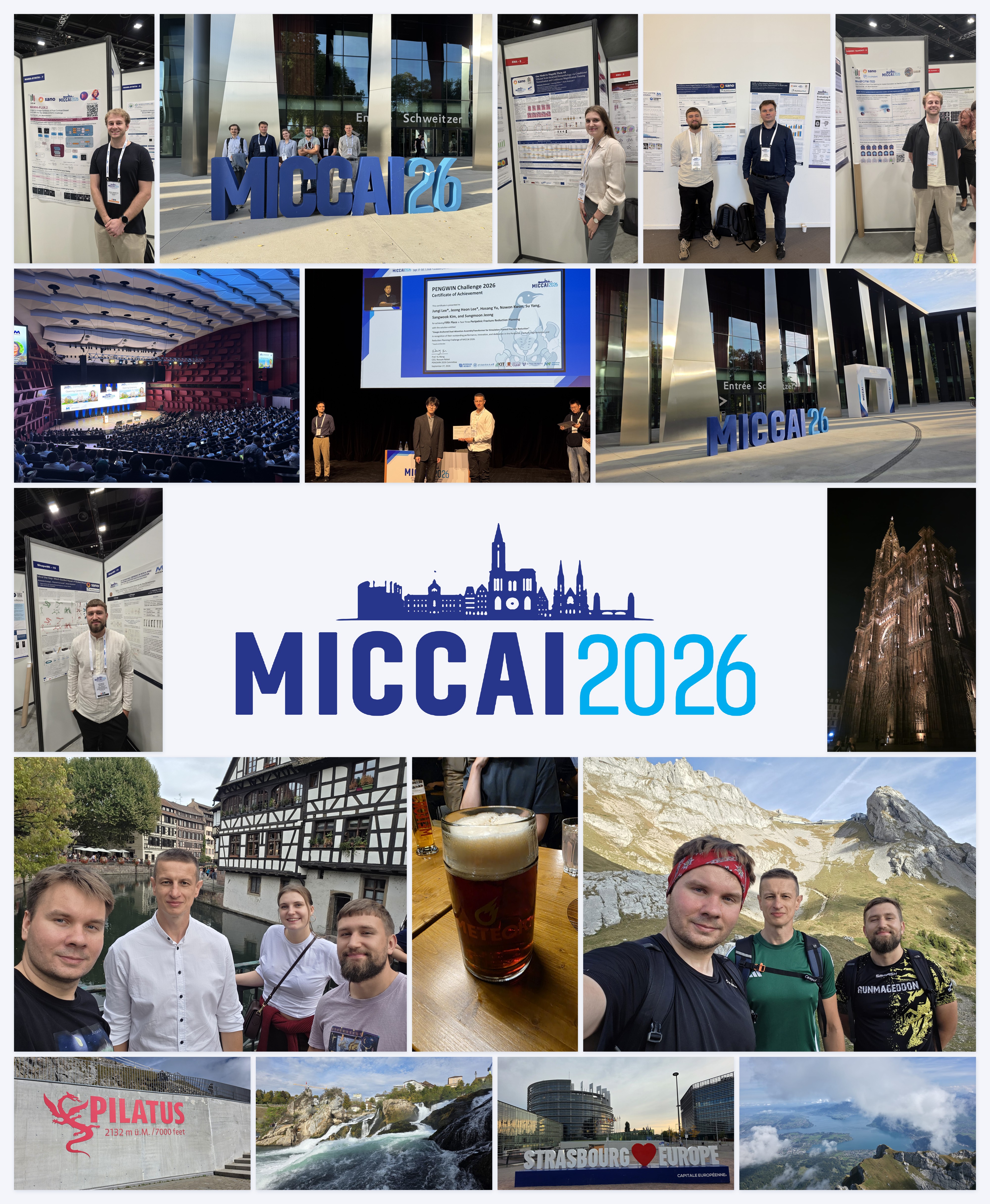
🎉 A Fantastic Week in Strasbourg

Wojciech Szymański, Gniewosz Drwięga, and Marek Wodziński represented the MultiGeoMed team at MICCAI 2026, held September 27 - October 1, 2026 in Strasbourg, France. The team presented three posters at the conference's satellite workshops, and came home with two Best Poster Awards!

🏆 Best Poster Award - ShapeMI

"Mind the Gap: Mesh-Guided Repair of Broken Vessels" (Gniewosz Drwięga, Wojciech Szymański, Marek Wodziński) received the Best Poster Award at the MICCAI Workshop on Shape in Medical Imaging (ShapeMI).
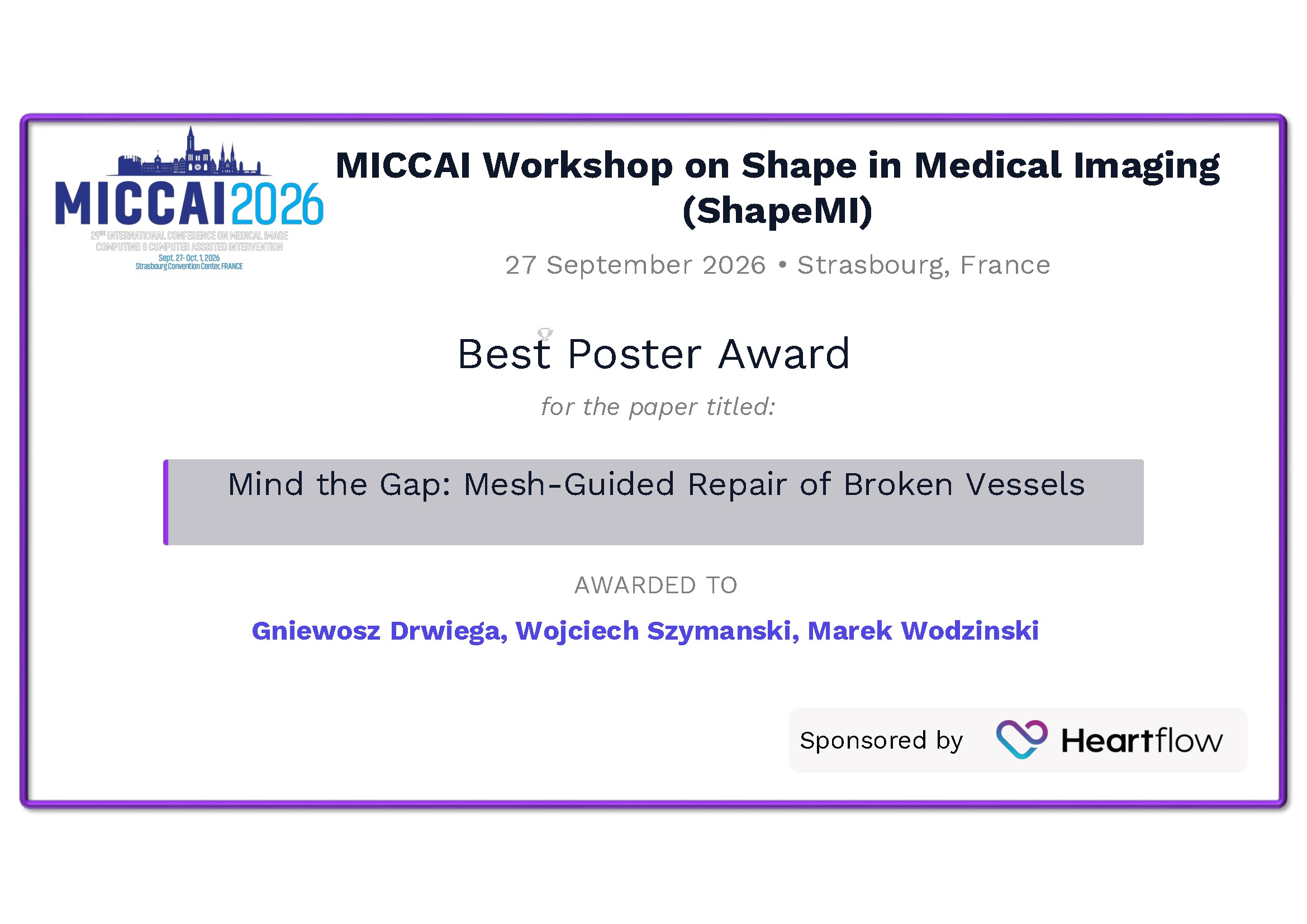
ShapeMI Best Poster Award

Read More

MultiGeoMed at ICVSS 2026

ICVSS2026

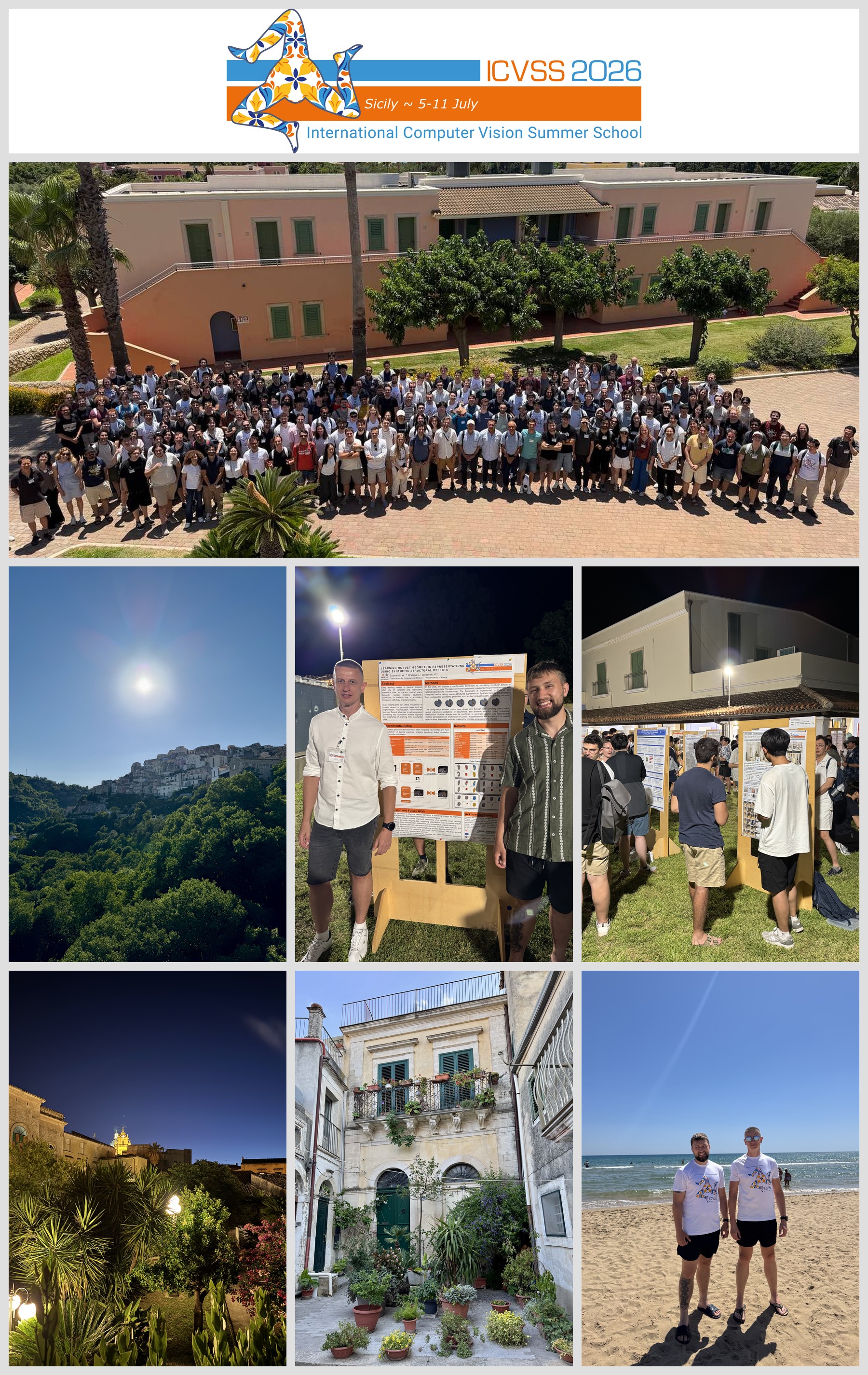
🏝️ A Week in Sicily

Wojciech Szymański and Gniewosz Drwięga attended the 2026 edition of the International Computer Vision Summer School (ICVSS), held on July 5-11, 2026 in Sicily, Italy. This year's school, titled "Computer Vision for Spatial and Physical Intelligence", marked its twentieth edition and brought together students and researchers from around the world for a week of lectures and poster sessions on the latest advances in computer vision.

🧩 Our Contribution

The team presented a poster entitled "Learning Robust Geometric Representations Using Synthetic Structural Defects" (Wojciech Szymański, Gniewosz Drwięga, Marek Wodziński), sharing our work on configurable synthetic defect simulation for masked self-supervised learning in medical imaging with the computer vision community.
Beyond the science, it was a fantastic week of learning, discussions, and exploring Sicily with researchers from all over the world.

Read More

MultiGeoMed at BioMeeting 2026

🗣️ Oral Presentation in Przesieka

Gniewosz Drwięga presented our research at BioMeeting 2026, held on May 22-24, 2026 at Zielona Gospoda in Przesieka, Poland. BioMeeting is an annual national conference bringing together student scientific circles and researchers from across Poland to exchange knowledge in bioinformatics and biomedical engineering.

📈 Our Contribution

Gniewosz gave an oral presentation entitled "High Dice, Broken Vessels: Evaluating Topology Errors in Deep Learning Vessel Segmentation", discussing how standard overlap-based metrics can mask significant topological errors in automatic vessel segmentation, and why topology-aware evaluation matters for clinically reliable results.

Read More

MultiGeoMed at AIMed 2026

AIMed2026

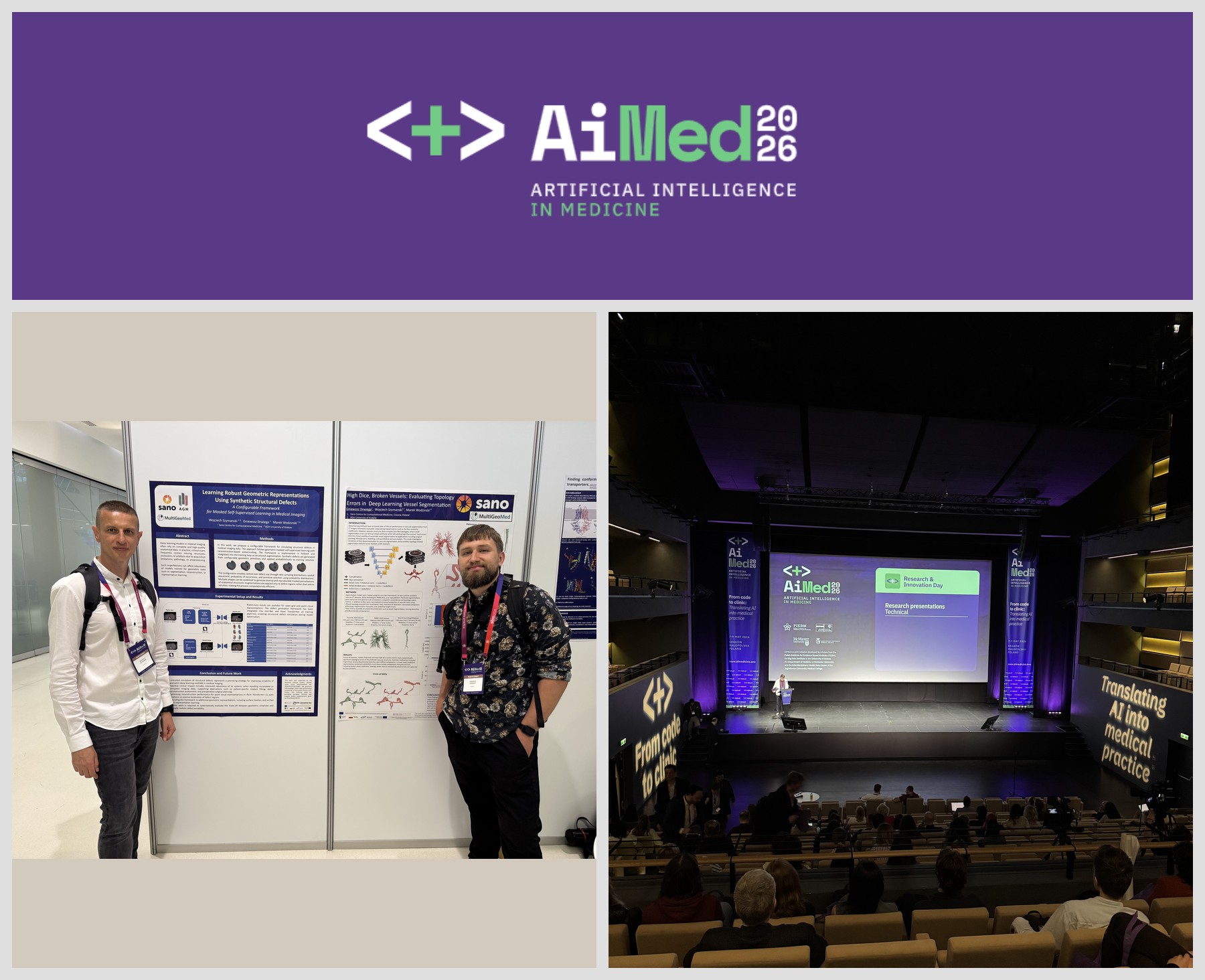
🎙️ Research & Innovation Day in Kraków

Wojciech Szymański and Gniewosz Drwięga represented the MultiGeoMed team at AIMed 2026, Artificial Intelligence in Medicine, held on May 7-9, 2026 in Kraków, Poland. The conference, themed "From code to clinic: Translating AI into medical practice", brought together researchers, clinicians, and industry experts working on AI applications in healthcare.

📊 Our Contributions

During the Research & Innovation Day, the team presented two posters:
  • 🧩 "Learning Robust Geometric Representations Using Synthetic Structural Defects: A Configurable Framework for Masked Self-Supervised Learning in Medical Imaging", by Wojciech Szymański, Gniewosz Drwięga, Marek Wodziński
  • 🩻 "High Dice, Broken Vessels: Evaluating Topology Errors in Deep Learning Vessel Segmentation", by Gniewosz Drwięga
It was a great opportunity to discuss our work on geometric deep learning and vascular segmentation with the broader AI-in-medicine community, right here in Kraków.

Read More

MultiGeoMed Project Started!

MultiGeoMed

🚀 Official Launch of MultiGeoMed

We are thrilled to announce the official launch of MultiGeoMed — a cutting-edge, multidisciplinary research project at the intersection of artificial intelligence, medical imaging, and geometric deep learning. MultiGeoMed aims to advance fundamental knowledge in multimodal geometric deep learning, a rapidly evolving field that explores how different geometric representations can be used together to improve performance in medical imaging tasks. Our goal is to push the boundaries of how machines understand and process complex anatomical structures.

🧠 What is MultiGeoMed About?

Medical imaging data can be represented in various geometric forms, each offering unique advantages. In this project, we will investigate how to simultaneously leverage multiple geometric representations, including:
  • 🧊 Voxel grids — the standard 3D pixel-based representation used in most medical scans.
  • 🕸️ Surface meshes — capturing the shape and topology of anatomical structures.
  • 🌐 Point clouds — sparse sets of 3D points representing objects.
  • 🧠 Implicit neural representations — continuous functions learned by neural networks to represent shapes and volumes.
By combining these modalities, we aim to develop more robust and generalizable AI models for medical image analysis.

🎯 Project Objectives

The project will address several key research questions:
  • 🔍 Which geometric representation provides the most benefit for specific downstream tasks in medical imaging?
  • 🔗 Can multiple representations be effectively fused to enhance the performance of geometric deep learning models?
  • 🧩 What are the most effective strategies for integrating these diverse geometric modalities?

Funding

The project is funded by National Science Centre, Poland under SONATA Grant no: 2024/55/D/ST6/02081. It is hosted at the Sano Science Research Center.

Read More