
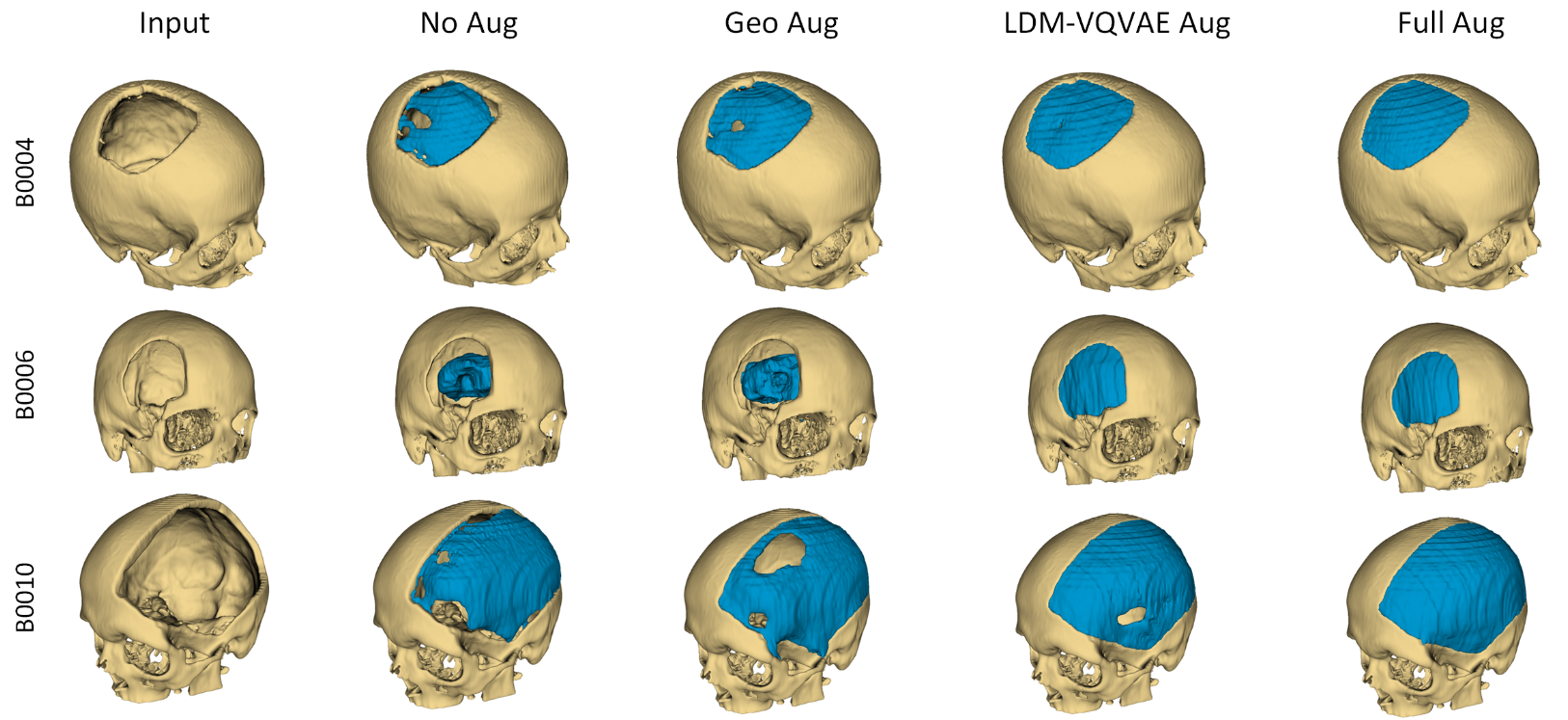
This paper has been published in Computers in Biology and Medicine (2024). It demonstrates that strong, diverse augmentation strategies - from registration-based transforms to latent-diffusion augmentations-— substantially improve reconstruction robustness for rare and noisy defects. The result is faster, more reliable automatic implant modeling that generalizes better to real clinical scans.