Announcing a new paper! MedPCFM-TED: One-Step Point Cloud Flow Matching for Implant Generation via Teacher-Guided Endpoint Distillation

DeepImplant

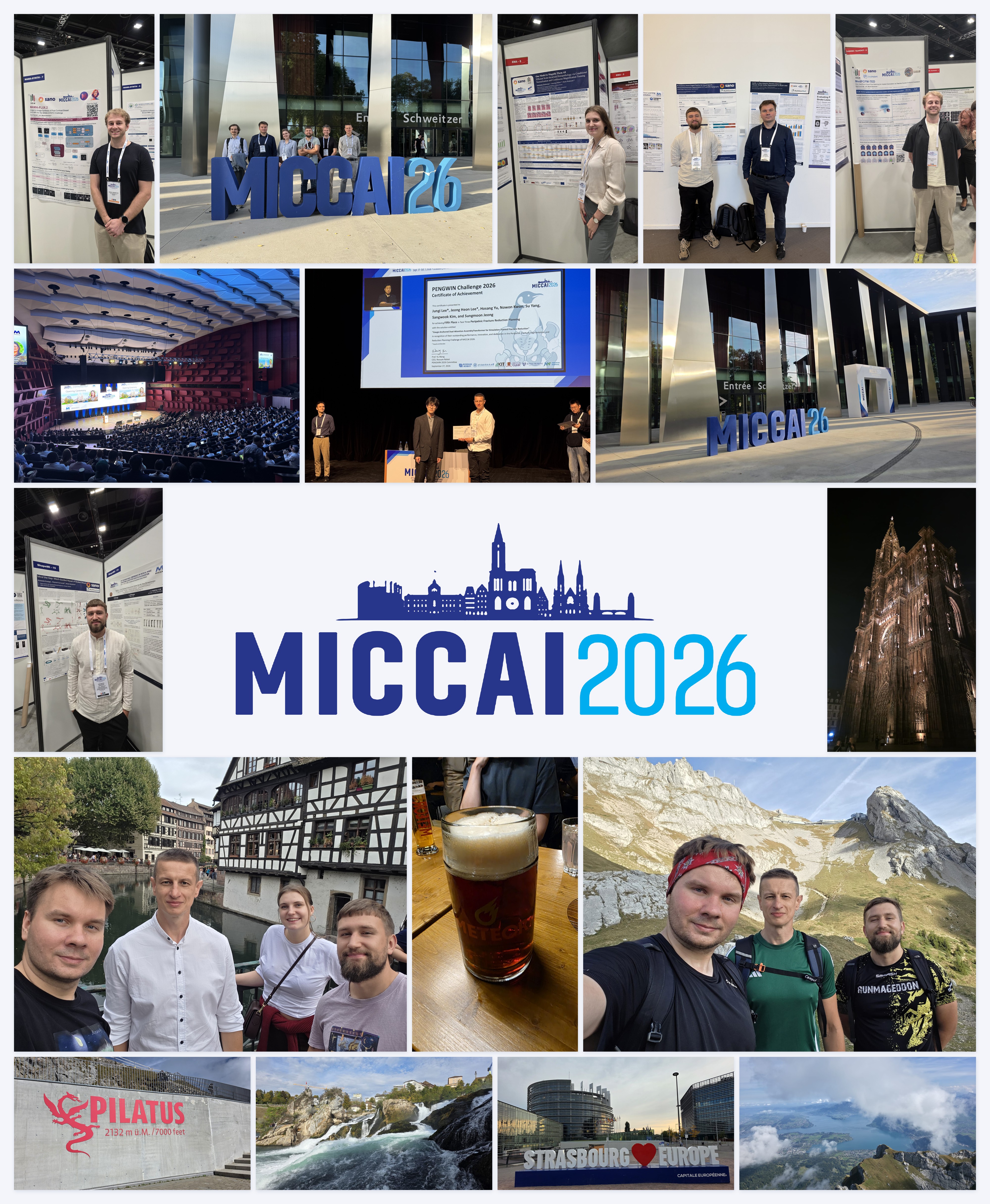
Our paper "MedPCFM-TED: One-Step Point Cloud Flow Matching for Implant Generation via Teacher-Guided Endpoint Distillation" (Kamil Kwarciak, Marek Wodziński) was accepted and presented at SASHIMI, the 11th International Workshop on Simulation and Synthesis in Medical Imaging, held on October 1, 2026 in Strasbourg, France as part of MICCAI 2026.
Point cloud flow matching produces high-quality cranial implant reconstructions, but sampling typically requires many neural function evaluations, which slows down generating multiple candidate implants. MedPCFM-TED introduces Teacher-guided Endpoint Distillation, a one-step distillation framework that trains a student model with teacher-guided endpoint supervision and geometric matching losses, without explicit path straightening. On the SkullFix and SkullBreak benchmarks, it performs best overall on SkullBreak, stays competitive on SkullFix, and achieves the strongest Chamfer distance among compared one-step methods, generating an implant in roughly 0.04 seconds, a substantial speed-up over iterative flow-matching sampling without sacrificing reconstruction quality.
Read the paper

Read More

Announcing a new paper! MedPCFM: Improving Medical Point Cloud Completion by Integrating Point Transformers and Flow Matching

DeepImplant

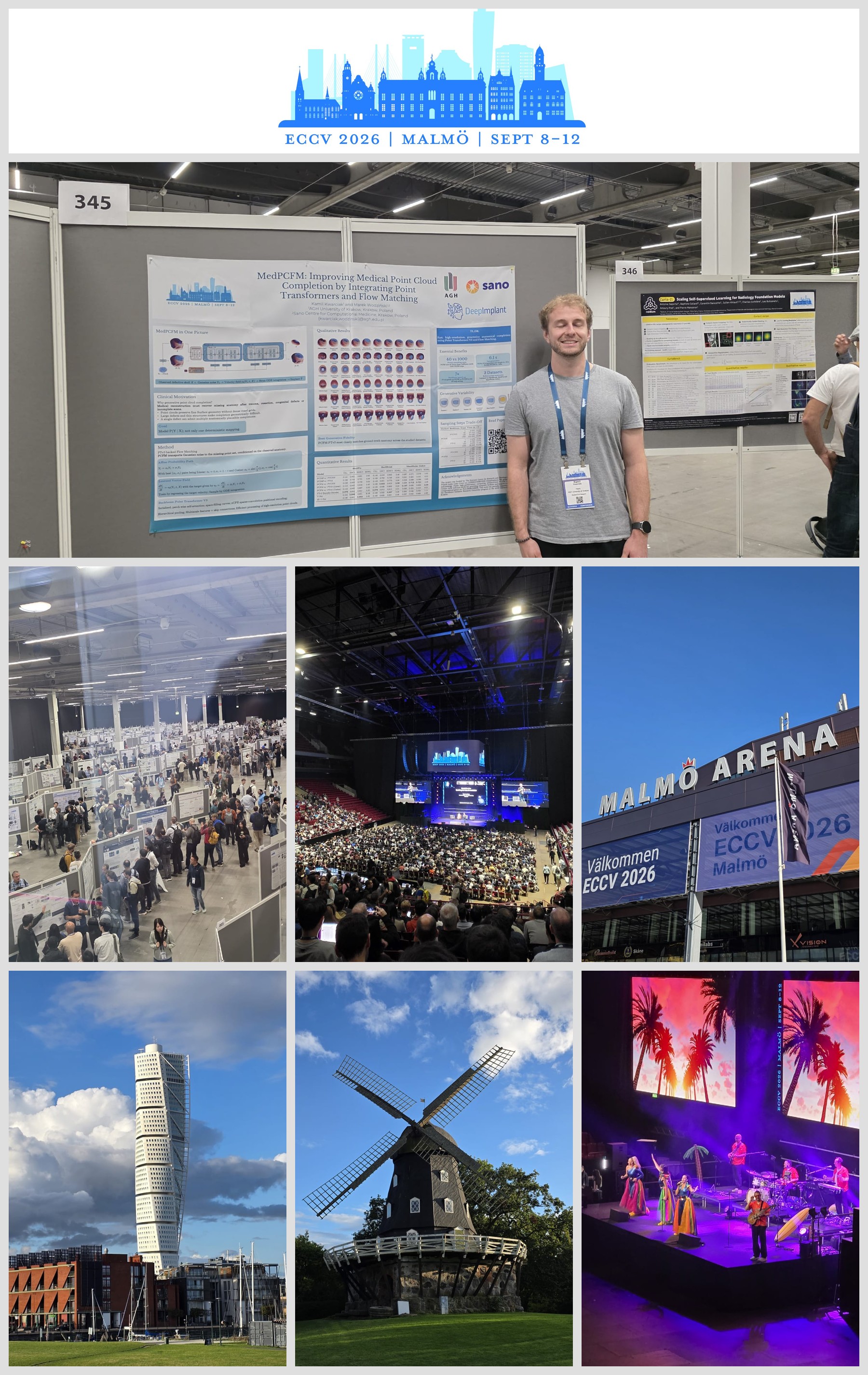
Our paper "MedPCFM: Improving Medical Point Cloud Completion by Integrating Point Transformers and Flow Matching" (Kamil Kwarciak, Marek Wodziński) was accepted and presented at AI4M3D, the workshop on Artificial Intelligence for Medical 3D Vision, held on September 9, 2026 in Malmö, Sweden as part of ECCV 2026.
Medical point cloud completion supports anatomical reconstruction, but generative approaches to it remain little studied. MedPCFM treats completion as continuous-time generative modeling, introducing PCFM, a flow matching method built on a Point Transformer V3 backbone, evaluated on the SkullFix, SkullBreak, and newer Mandibular Defect datasets. PCFM with PTv3 performs comparably to a deterministic PTv3 baseline while achieving the best generative results across all three datasets, and needs far fewer sampling steps than diffusion-based alternatives, giving up to a 7x throughput gain over a PVCNN backbone. A scaling study across model size and point count also shows consistent gains at higher point resolution.

Read the paper

Read More

Polityka Scientific Award!

DeepImplant

🏆 Thrilled to share some exciting news! Marek Wodzinski has been awarded the 25th POLITYKA Scientific Award in the category of Technical Sciences 🎓
This recognition honors Marek's research in automatic medical image analysis, with a special focus on the automatic design of personalized bone implants. It’s incredibly rewarding to see how AI-driven solutions can support personalized medicine and improve patient outcomes.
Let’s keep building, discovering, and sharing science that matters.
Photo by: Teodor Klepczyński/Leszek Zych/POLITYKA

Read More

Announcing a new paper! Unsupervised Skull Segmentation in MR Images Utilizing Modality Translation and Super-Resolution

DeepImplant

This paper has been published in Scientific Reports (2025). It presents an automated pipeline that translates MR images to CT-like contrast and applies super-resolution to enable accurate, unsupervised skull segmentation, dramatically speeding preparation of 3D skull geometry for implant design. The method reduces reliance on manual labels and improves robustness on clinical data, helping DeepImplant extract bone geometry faster and more reliably.

Read More

InnoDiament Award!

DeepImplant

The Master Thesis authored by Kamil Kwarciak has been honored with the prestigious InnoDiament Award! 🏆 This award is given to a single, carefully selected thesis at AGH University of Kraków for its outstanding practical potential - and I had the pleasure to be the supervisor!
Kamil’s thesis, titled “Unsupervised Segmentation of Defective Skulls in Volumetric Data Using Deep Networks Dedicated to Modality Transfer” delves into the innovative approach of automatic skull segmentation from magnetic resonance volumes. By applying unsupervised modality transfer to computed tomography, the thesis demonstrates how skulls can be directly segmented using simple thresholding techniques, without using any ground-truth annotations. This amazing work was part of the DeepImplant project, funded by NCBR.
Adding to this achievement, the thesis also secured 3rd place in the Diamenty AGH competition! 🥉

Read More